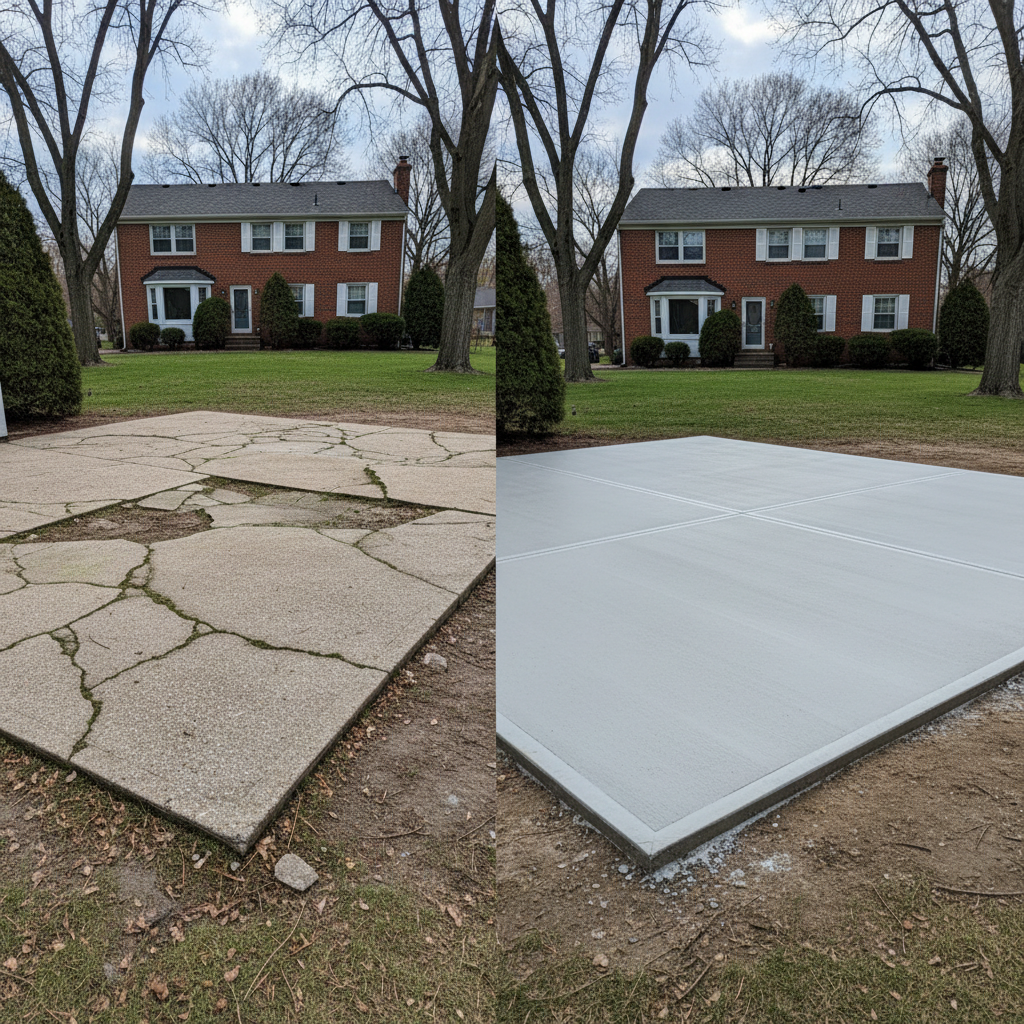
Alright, let's talk foundations. When you're building a new home, adding an addition, or even just replacing a failing foundation here in Des Plaines, you've mainly got two big choices for concrete: poured concrete or concrete block. Both get the job done, but they're definitely not the same. As someone who's poured and laid a lot of both, I can tell you there are some real differences you need to know about.
Poured Concrete Foundations: The Solid Choice
Poured concrete foundations are exactly what they sound like: we build forms, usually out of wood or steel, and then pour ready-mix concrete right into them. Once it cures, you've got one solid, monolithic wall.
Durability & Strength: This is where poured concrete really shines, especially for us here in Illinois. You get a continuous, seamless wall. That means fewer joints, and fewer joints mean less opportunity for water to find its way in. It's incredibly strong and resists lateral pressure from the soil really well. With our freeze-thaw cycles and sometimes expansive clay soils in areas like the older sections near downtown Des Plaines, that continuous strength is a big plus.
Water Resistance: Because it's one solid piece, poured concrete is inherently more resistant to water penetration than block. You still need proper waterproofing and drainage, don't get me wrong, but the risk of leaks through mortar joints is practically eliminated.
Installation: Poured foundations can often be put in faster than block, assuming good weather and a reliable concrete delivery. Once the forms are up, it's a matter of pouring and then stripping the forms after curing.
Cost: Generally, poured concrete can be a bit more expensive upfront than block. The forming process requires specialized equipment and skilled labor. However, that initial cost often pays off in long-term durability and lower maintenance.
Appearance: You get a smooth, uniform surface. If you're planning on leaving the foundation exposed in a basement, it looks clean and modern.
Concrete Block Foundations: The Traditional Route
Concrete block foundations, or CMU (Concrete Masonry Unit) foundations, are built by stacking individual concrete blocks and mortaring them together. It's a tried-and-true method that's been used for ages.
Durability & Strength: Block foundations are strong, no doubt about it. But their strength comes from the individual blocks and the mortar joints holding them together. Those joints are the weakest link. They can be susceptible to cracking if there's significant lateral pressure or ground movement. To increase strength, we often fill the cores of the blocks with rebar and concrete, especially in critical areas.
Water Resistance: This is the biggest challenge with block. Every single mortar joint is a potential pathway for water. Without meticulous waterproofing and drainage, you're more likely to experience moisture issues in a block foundation basement. I've seen plenty of older Des Plaines homes with block foundations that struggle with dampness.
Installation: Laying block is labor-intensive and takes time. It's skilled work, but it can be done in stages, which can be an advantage on some complex sites or if you're dealing with tricky access. It's also less dependent on immediate concrete delivery schedules.
Cost: Often, block foundations have a lower initial material and labor cost compared to poured concrete. This can be appealing for budget-conscious projects.
Appearance: You get the distinct look of stacked blocks. It's a classic, utilitarian look. If you're finishing the basement, you'll need to cover these walls anyway.
My Recommendation for Des Plaines Homeowners
Look, both foundation types can work. But if you're asking me, for most new construction or major additions here in Des Plaines, I'm going to lean towards poured concrete every single time.
Why? Our climate. We get serious temperature swings, heavy rains, and that freeze-thaw cycle really puts foundations to the test. The continuous, seamless strength of a poured concrete wall just handles those stresses better. It's inherently more watertight, which means less headaches down the road dealing with a damp basement. While the upfront cost might be a little higher, the long-term peace of mind and reduced risk of water intrusion are well worth it.
Now, if you're doing a small, non-structural project, or if access is extremely limited, block might still be a viable option. But for your main foundation, especially if you're planning on finishing your basement, poured concrete is the superior choice for durability and moisture control in our local conditions.
At Classic Concrete Co, we've got the experience with both, and we can help you figure out the best approach for your specific project. Give us a call, and we can walk through your options.